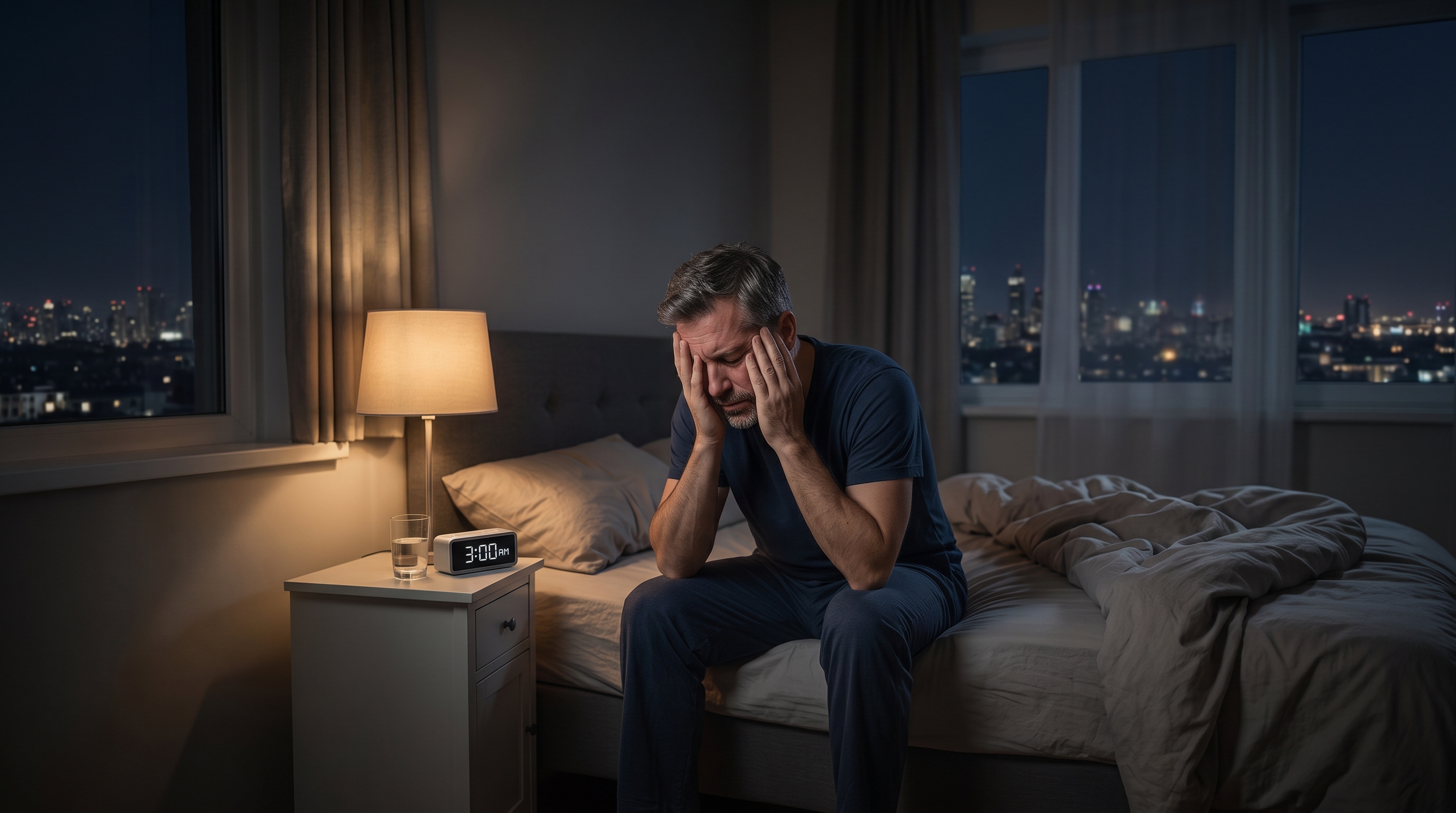
// The Physiological Logic
Sleep is divided into two distinct biological phases. The first half is packed with deep Stage 3 slow-wave sleep. By 3 AM, your brain transitions into lighter REM cycles while core body temperature drops and the liver must release stored glycogen to sustain blood sugar.
Why 3 AM Is the Most Vulnerable Hour of Your Sleep Cycle
If you find yourself opening your eyes at 3:14 AM with your thoughts already running at full speed, you are not alone. Waking during the 3 AM to 4 AM window is one of the most common complaints in clinical medicine. It represents a predictable physiological crossroads where brain wave architecture, glucose metabolism, and stress chemistry intersect.
How nocturnal cortisol surges, reactive hypoglycemia, and sleep fragmentation cause 3 AM awakenings
Between 2 AM and 4 AM, liver glycogen stores can run low, especially after high-glycemic dinners or prolonged fasting. If blood glucose drops below optimal levels, your adrenal glands release a burst of cortisol and epinephrine to stimulate hepatic gluconeogenesis. This surge of counter-regulatory hormones raises blood pressure and heart rate, jarring the cortex into conscious wakefulness.
Sudden alertness at 3 AM with a racing heart is often a biochemical emergency response to low nocturnal blood sugar.
What causes nocturnal wakefulness: alcohol rebound, liver glycogen dips, and sympathetic spikes
While alcohol initially acts as a GABA agonist that induces sleepiness, its hepatic metabolism by alcohol dehydrogenase produces a rebound sympathetic excitation 4 to 5 hours later. Blood vessels dilate, heart rate jumps by 10 to 15 bpm, and body temperature rises, fragmenting sleep precisely in the early morning hours.
An evening drink may help you fall asleep, but its metabolic clearance virtually guarantees a 3 AM awakening.
How sleep architecture shifts between deep non-REM and light REM sleep in the second half of the night
During the first four hours of sleep, your brain is anchored in delta slow-wave sleep, which has an extremely high awakening threshold. After 3 AM, sleep is dominated by Stage 2 and REM sleep, where the arousal threshold is dramatically lower. Any subtle stimulus—an uncomfortably warm room, a full bladder, or mild airway collapse—will wake you.
You wake at 3 AM because your sleep is naturally shallower and far more sensitive to internal and external disruptions.
How to fall back asleep quickly without checking the clock or triggering adrenaline
Checking the time on your phone is the single fastest way to cement a 3 AM waking pattern. Screen light suppresses melatonin, while seeing the hour triggers cognitive catastrophe ('I only have 3 hours left'). Keep the room dark, keep your eyes softly closed, breathe with extended 6-second exhalations, and do not get out of bed unless you have been awake for over 25 minutes.
Never check the clock; calculating remaining sleep time stimulates the prefrontal cortex and restarts adrenaline.
When to Seek Medical Care
- • Waking abruptly with gasping, choking, heart palpitations, or a dry, parched throat (obstructive sleep apnea warning signs).
- • Soaking night sweats that require changing sheets or clothes, especially accompanied by unintentional weight loss or low-grade fever.
- • Severe crushing chest pain, pressure, or tightness radiating to the arm, neck, or back upon waking.
- • Waking with severe sudden shortness of breath that improves only when sitting completely upright (orthopnea / heart failure).
- • Severe early-morning panic attacks with feelings of impending doom, confusion, or inability to move.
What to Do Next
Keep a 7-day sleep log recording dinner time, alcohol intake, bedtime, exact waking times, and morning energy levels. Present this structured log to a clinician or sleep specialist if night waking persists beyond three weeks.
"Night waking is not a failure of your willpower; it is a metabolic and autonomic mirror of your day. The nervous system does not reset at bedtime; it carries forward every unpaid debt from your daytime hours."
What DrLina Notices Often
Patients blame 'bad sleep' when the true culprit was an 8 PM glass of wine or high-sugar dessert.
Looking at the bedside clock transforms a natural 90-second micro-arousal into a 90-minute panic episode.
Undiagnosed obstructive sleep apnea is the most common organic medical cause of 3 AM awakenings in adults.
A small protein-and-fat bedtime snack (like a spoonful of almond butter) prevents hypoglycemic surges in 60% of cases.
3 AM Nocturnal Glucose & Cortisol Clock
A meal high in simple carbohydrates triggers early postprandial insulin surges. By hour 4-5, blood glucose drops below 70 mg/dL, causing the liver to trigger a compensatory epinephrine/cortisol release that awakens you with a pounding heart.
// How DrLina Can Help You : Why Your Body Wakes You Up at 3AM Repeatedly

This care card summarizes how DrLina AI clarifies physiological signals and symptoms. Repeated 3 AM awakenings stem from the physiological transition from deep slow-wave sleep to REM-predominant cycles, where subclinical cortisol surges, reactive hypoglycemia, alcohol withdrawal rebound, or upper airway collapse easily breach the arousal threshold.
Why Your Body Wakes You Up at 3AM Repeatedly
Repeated waking around 3AM happens when the second half of your sleep architecture—dominated by light REM sleep—meets cortisol surges, liver glycogen depletion, alcohol metabolism, or breathing disruptions.
“Repeated 3 AM awakenings stem from the physiological transition from deep slow-wave sleep to REM-predominant cycles, where subclinical cortisol surges, reactive hypoglycemia, alcohol withdrawal rebound, or upper airway collapse easily breach the arousal threshold.”
Physical anomalies (such as persistent morning exhaustion, unrefreshing sleep, or cognitive fatigue) are multifactorial and can stem from lifestyle factors, psychological stress, or formal medical conditions. If you experience severe daytime somnolence that risks driving safety, nocturnal breathing pauses or choking, sudden chest pain, or neurological deficits, immediately schedule an in-person diagnostic evaluation with a qualified medical professional.
What to Ask DrLina About This
Tap any question to place it directly into the clinical companion workspace.
Frequently Asked Clinical Questions
Why do I always wake up at the exact same minute (e.g. 3:17 AM)?
Sleep operates on ultradian cycles lasting approximately 90 to 110 minutes. If you consistently fall asleep around 11:00 PM, your third sleep cycle naturally ends right around 3:00 to 3:30 AM. A micro-arousal that coincides with your circadian body temperature drop or a habitual cortisol release quickly becomes an internal conditioned reflex.
Can a drop in blood sugar wake you up from a sound sleep?
Yes. When blood glucose drops below roughly 70 mg/dL during the night, the brain detects an energetic crisis. Because brain cells cannot survive without glucose, the adrenal medulla secretes epinephrine (adrenaline) and cortisol to force the liver to release emergency glycogen. This adrenaline spike awakens you instantly with racing thoughts and a pounding pulse.
What should I do if I cannot fall back asleep after 20 minutes?
Get out of bed quietly, keeping lights as dim as possible. Move to a comfortable chair in another room and read a physical book or listen to calming audio. Avoid looking at any screens or clocks. Return to bed only when your eyelids feel heavy. This prevents your brain from associating your bed with sleepless frustration.
Repeated 3 AM awakenings stem from the physiological transition from deep slow-wave sleep to REM-predominant cycles, where subclinical cortisol surges, reactive hypoglycemia, alcohol withdrawal rebound, or upper airway collapse easily breach the arousal threshold.
Primary Scientific Citations
Synthesized by the DrLina Clinical Intelligence Engine and reviewed by the Dr. Lina AI Medical Board against peer-reviewed clinical benchmarks:
Nocturnal awakening patterns, cortisol circadian dynamics, and autonomic arousal in middle-of-the-night insomnia
Hypoglycemia-induced nocturnal awakenings: counter-regulatory epinephrine surges and sleep architecture disruption
Sleep maintenance insomnia and nocturnal sympathovagal imbalance: diagnostic criteria and behavioral management
Malaria, Flu, or Stress? How to Tell the Difference
Why fever, body aches, and fatigue overlap between malaria, viral influenza, and severe stress, and when to test immediately.