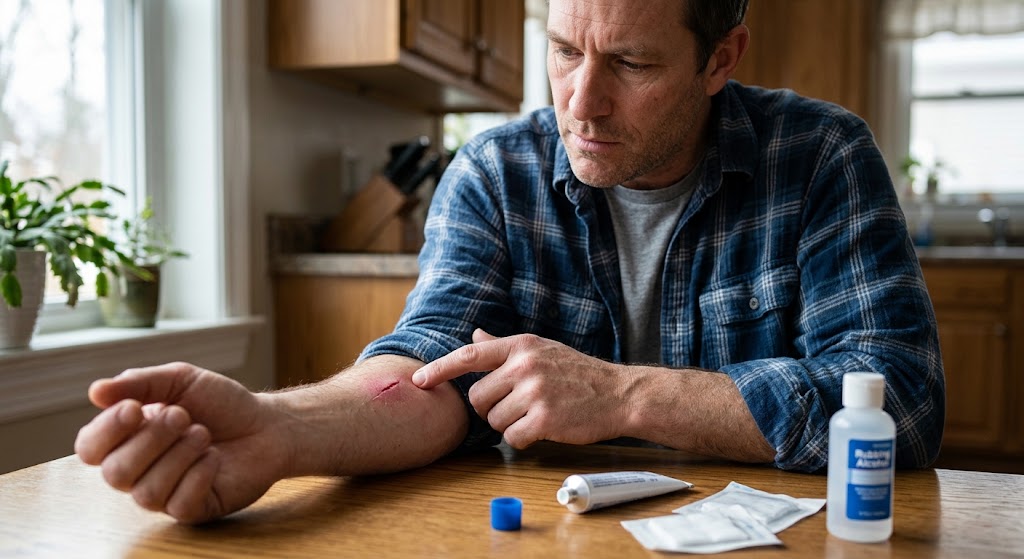
// The Physiological Logic
During normal healing, localized inflammation peaks within 48 to 72 hours and remains confined to the incision margin. When bacterial colonization transitions into critical bioburden and tissue invasion (commonly Staphylococcus aureus or Streptococcus pyogenes), pathogens breach collagen matrices. This triggers profound vasodilation, leukocyte necrosis (forming purulent exudate), and lymphangitic spread requiring antimicrobial intervention.
How to Tell If a Cut is Healing or Harboring Infection
Every break in the skin provokes an initial inflammatory response—mild redness and tenderness are natural signs of immune mobilization. However, true bacterial infection behaves like an expanding fire rather than a contained spark. Recognizing the transition between physiologic inflammation and invasive infection prevents deep soft-tissue complications and systemic sepsis.
Normal Healing Redness vs. Spreading Bacterial Cellulitis
Normal post-injury erythema forms a narrow, uniform collar (1–2 mm) right at the incision margin that fades after day 3. In contrast, bacterial cellulitis produces an uneven, fiery, expanding border that creeps outward across healthy skin. Clinicians recommend outlining the red margin with a clean pen: if the erythema crosses the line within 6 to 12 hours or skin feels intensely hot (calor), bacteria have invaded viable dermis.
Normal healing redness stays tightly confined and fades after 72 hours; spreading, expanding redness indicates active bacterial cellulitis.
Exudate Dynamics: Serous Fluid vs. Purulent Bacterial Pus
A clean healing cut produces clear, straw-colored serous fluid or thin blood-tinged plasma essential for keeping cells moist. Infection transforms this exudate into thick, cloudy, opaque yellow or green pus. This foul-smelling purulent discharge consists of millions of dead neutrophils, degraded cellular matrices, and living bacterial colonies trapped in the wound bed.
Clear or pale yellow moisture aids cellular migration; thick, milky, opaque, or foul-smelling drainage is pus indicating bacterial colonization.
Pain Trajectory: Resolving Tenderness vs. Deep Throbbing Ache
Uncomplicated wound pain follows a clear downward trajectory: sharpest at the moment of injury, transitioning into dull tenderness that steadily subsides by day 3. Conversely, escalating throbbing pain, especially waking you from sleep or accompanied by a tight feeling of tissue pressure, signals expanding edema and purulent tension within the fascial compartments.
Pain that escalates in severity after 48 hours is abnormal and strongly suggests deep tissue infection.
Red Streaks and Systemic Sepsis: When Hours Matter
The appearance of thin red lines or streaks tracking along an arm or leg away from the wound marks acute lymphangitis—bacteria traveling through lymphatic vessels toward regional lymph nodes. If accompanied by systemic signs such as fever (>38°C/100.4°F), shaking chills, rigors, dizziness, or nausea, infection has entered circulation and requires emergency IV antibiotic evaluation.
Red streaks extending up a limb and systemic fever are medical emergencies requiring immediate clinical intervention.
When to Seek Medical Care
- • Circumferential redness expanding rapidly (>2 cm margin) or crossing a pen outline.
- • Thick yellow, green, or foul-smelling purulent discharge oozing from the wound.
- • Red streaks tracking up the limb toward the armpit or groin (acute lymphangitis).
- • Systemic fever (>38°C / 100.4°F), rigors, shaking chills, or profound lethargy.
- • Pain or localized swelling that steadily worsens rather than improves after 48 hours.
- • Immunocompromised status, active chemotherapy, peripheral neuropathy, or uncontrolled diabetes.
What to Do Next
DrLina provides educational triage and physiological analysis. Active bacterial infections, spreading cellulitis, or systemic fevers cannot be resolved with home antiseptics alone and require prescription antimicrobial therapy.
"Infection is defined by trajectory, not a single snapshot. A wound that looks calm and decreases in sensitivity is repairing; a wound that grows hotter, wider, and more painful over 24 hours is requesting urgent medical backup."
What DrLina Notices Often
Patients frequently confuse natural yellowish fibrinous slough (a normal moist healing tissue protein) with purulent infection, leading them to aggressively scrub the bed and damage fragile new capillaries.
Spreading Erythema & Bacterial Bioburden Scale
Wound edges remain approximated and superficial. Clean with sterile water/saline, apply protective dressing, and monitor margins daily.
// How DrLina Can Help You : Signs a Wound May Be Infected

This care card summarizes how DrLina AI clarifies physiological signals and symptoms. Wound infection is clinically differentiated by spreading circumferential erythema (> 2cm margin), localized calor (radiating heat), purulent malodorous exudate, increasing throbbing pain, and lymphangitic red streaking.
Signs a Wound May Be Infected
A wound may be infected if redness expands outward, the area feels hot, swelling increases, cloudy or foul-smelling pus oozes, or pain throbs rather than settles.
“Wound infection is clinically differentiated by spreading circumferential erythema (> 2cm margin), localized calor (radiating heat), purulent malodorous exudate, increasing throbbing pain, and lymphangitic red streaking.”
Physical anomalies (such as persistent morning exhaustion, unrefreshing sleep, or cognitive fatigue) are multifactorial and can stem from lifestyle factors, psychological stress, or formal medical conditions. If you experience severe daytime somnolence that risks driving safety, nocturnal breathing pauses or choking, sudden chest pain, or neurological deficits, immediately schedule an in-person diagnostic evaluation with a qualified medical professional.
What to Ask DrLina About This
Tap any question to place it directly into the clinical companion workspace.
Frequently Asked Clinical Questions
What does an infected wound look like compared to a normal healing wound?
A normal healing wound improves daily with redness confined to the incision line and swelling subsiding within 72 hours. An infected wound features expanding fiery redness, radiating skin heat, intensifying throbbing pain, and thick yellow or greenish foul-smelling pus.
What do red streaks leading from a wound mean?
Red streaks running up an arm or leg indicate acute lymphangitis—bacterial infection traveling through the lymphatic vessels toward the bloodstream. This is a time-critical medical emergency requiring urgent intravenous or oral antibiotics.
Can I treat an infected wound with over-the-counter antiseptic ointments?
Topical ointments cannot penetrate deep dermis once invasive cellulitis has begun. If erythema is expanding or pus is present, an in-person clinical exam and systemic antibiotics are necessary to halt bacterial spread.
Wound infection is clinically differentiated by spreading circumferential erythema (> 2cm margin), localized calor (radiating heat), purulent malodorous exudate, increasing throbbing pain, and lymphangitic red streaking.
Primary Scientific Citations
Synthesized by the DrLina Clinical Intelligence Engine and reviewed by the Dr. Lina AI Medical Board against peer-reviewed clinical benchmarks:
Clinical identification of acute and chronic wound infection: the International Wound Infection Institute (IWII) consensus guidelines
Distinguishing physiological inflammatory erythema from spreading bacterial cellulitis: objective thermal and margin metrics
Biofilm formation, delayed healing kinetics, and microbiological surveillance in open epithelial trauma
How to Tell If a Wound Needs Medical Care
Understand critical laceration closure windows, tension gaping, and tetanus prophylaxis criteria.