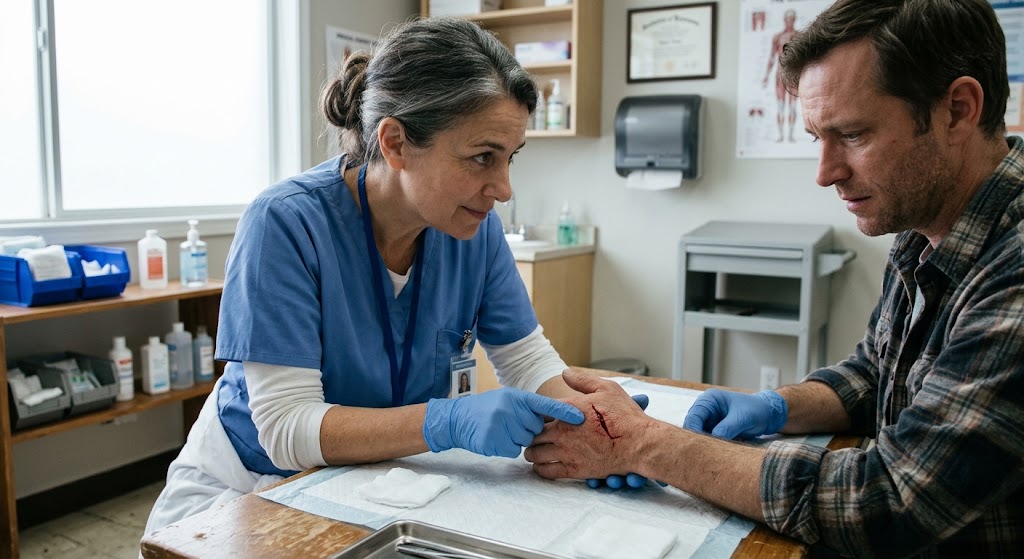
// The Physiological Logic
Primary intention healing depends on precise anatomical approximation of dermal margins. When lacerations penetrate full-thickness dermis into subcutaneous adipose lobules or fascia, natural tension vectors pull edges apart. Closing these gaps within 6 to 8 hours prevents secondary intention scarring, chronic microbial colonization, and anaerobic Clostridium tetani replication.
Deciding Between Home First-Aid and Urgent Medical Care
Minor superficial scrapes heal cleanly with gentle washing and sterile dressings. However, deep lacerations carry unseen structural risks: severed digital nerves, transected tendons, and anaerobic bacterial seeding. Recognizing the physiological thresholds for surgical repair ensures prompt intervention within critical clinical timeframes.
Hemostasis Failure: The 10-Minute Continuous Pressure Rule
Capillary oozing normally clots within 3 to 5 minutes. If continuous, uninterrupted direct manual pressure with clean gauze fails to stop bleeding after 10 full minutes, or if blood spurts rhythmically in pulses, an arterial branch or substantial vein has been breached. This requires surgical ligation, cauterization, or layered compression.
Continuous bleeding despite 10 minutes of uninterrupted direct pressure or pulsating arterial spurts requires urgent clinical management.
Depth and Tissue Anatomy: The Yellow Fat and Gaping Margin Rule
Examine the wound bed under good light. If the cut gapes open like a canyon and edges do not stay together naturally, or if you observe bubbly yellowish subcutaneous fat, silvery tendon sheets, or muscle fibers, full-thickness dermis has separated. Such wounds cannot close smoothly on their own and require layered dermal suturing.
Visible yellow adipose tissue, muscle fibers, or edges gaping wider than 5 mm require formal surgical approximation.
High-Risk Injury Mechanisms: Bites, Rust, and Dirty Punctures
Mechanism dictates infection risk far more than wound size. Animal and human bites inject dense polymicrobial oral flora (e.g., Pasteurella multocida) deep into tissues, mandating prophylactic antibiotics. Stepping on rusty nails or soil-contaminated glass carries high Clostridium tetani spores, necessitating booster vaccination if more than 5 years have elapsed.
Bites, puncture wounds, and dirty or rusty penetrations carry severe infectious risks requiring prompt professional sanitization.
The Golden Window: The 6-to-8 Hour Primary Closure Limit
Timing is decisive. Bacteria introduced into a wound multiply exponentially. Beyond 6 to 8 hours (or 12 to 24 hours on the face due to superior vascularity), closing the skin with stitches traps established bacterial colonies inside, dramatically increasing abscess risk. Delaying past this window may force clinicians to leave the wound open for delayed closure.
Primary closure with stitches must occur within 6 to 8 hours of injury to avoid sealing active bacteria under the skin.
When to Seek Medical Care
- • Pulsatile arterial spurting or bleeding that soaks through dressings after 10 minutes of direct pressure.
- • Visible yellow subcutaneous fat, glistening tendon, white fascia, or muscle within the wound.
- • Wound edges that remain widely parted (>5 mm) and cannot be kept together easily.
- • Loss of sensation, tingling, numbness, or inability to move fingers/toes beyond the cut.
- • Injuries caused by animal or human bites, rusty metal, deep punctures, or high-pressure equipment.
- • Injury occurring more than 6 to 8 hours ago without prior medical cleaning.
What to Do Next
DrLina provides surgical and anatomical triage guidance. Active arterial bleeding, open fractures, and deep gaping lacerations are medical emergencies that must be evaluated immediately in an emergency department.
"Evaluating a wound is an anatomical assessment. What layer did the blade reach? What bacteria entered? How many hours have elapsed? Answering these three questions determines whether home care is safe."
What DrLina Notices Often
Patients frequently peek at a bleeding wound every 30 seconds to check if it stopped, repeatedly dislodging fragile new platelet plugs and erroneously believing the bleeding is uncontrollable.
6-Hour Laceration & Tetanus Triage Tool
Wound edges remain approximated and superficial. Clean with sterile water/saline, apply protective dressing, and monitor margins daily.
// How DrLina Can Help You : How to Tell If a Wound Needs Medical Care

This care card summarizes how DrLina AI clarifies physiological signals and symptoms. A wound requires urgent medical closure if it gapes wider than 5mm, exposes subcutaneous adipose tissue or muscle fascia, bleeds continuously despite 10 minutes of direct pressure, involves joint mobility, or exceeds the 6-hour primary closure window.
How to Tell If a Wound Needs Medical Care
A wound requires clinical care if bleeding persists past 10 minutes of direct pressure, edges gape wider than 5 mm, yellow subcutaneous fat is visible, or the injury involves dirty puncture, animal bites, or rusty metals.
“A wound requires urgent medical closure if it gapes wider than 5mm, exposes subcutaneous adipose tissue or muscle fascia, bleeds continuously despite 10 minutes of direct pressure, involves joint mobility, or exceeds the 6-hour primary closure window.”
Physical anomalies (such as persistent morning exhaustion, unrefreshing sleep, or cognitive fatigue) are multifactorial and can stem from lifestyle factors, psychological stress, or formal medical conditions. If you experience severe daytime somnolence that risks driving safety, nocturnal breathing pauses or choking, sudden chest pain, or neurological deficits, immediately schedule an in-person diagnostic evaluation with a qualified medical professional.
What to Ask DrLina About This
Tap any question to place it directly into the clinical companion workspace.
Frequently Asked Clinical Questions
How do I know if my cut needs stitches?
A cut likely requires stitches if it is deeper than 6 mm (1/4 inch), gapes open so that edges do not stay together naturally, exposes yellow subcutaneous fat or muscle, or is located over a flexing joint or the face.
How long do I have to get stitches after an injury?
Most body wounds must be evaluated and sutured within 6 to 8 hours of injury. Beyond this timeframe, closing the skin risks trapping proliferating bacteria, which can cause serious subcutaneous abscesses.
When do I need a tetanus shot after a cut?
You need a tetanus booster if the wound is dirty, rusty, contaminated with soil, or a deep puncture, and your last booster was more than 5 years ago (or more than 10 years for a clean superficial laceration).
A wound requires urgent medical closure if it gapes wider than 5mm, exposes subcutaneous adipose tissue or muscle fascia, bleeds continuously despite 10 minutes of direct pressure, involves joint mobility, or exceeds the 6-hour primary closure window.
Primary Scientific Citations
Synthesized by the DrLina Clinical Intelligence Engine and reviewed by the Dr. Lina AI Medical Board against peer-reviewed clinical benchmarks:
Wound closure protocols: timing, structural depth assessment, and emergency department triage thresholds for primary closure
Tetanus prophylaxis, neurovascular integrity evaluation, and deep fascial compromise in penetrating and lacerating trauma
Full-thickness dermal loss, tendon exposure, and animal bite management: antibiotic stewardship and surgical referral guidelines
Signs a Wound May Be Infected
Learn how to differentiate normal inflammatory redness from spreading bacterial cellulitis.