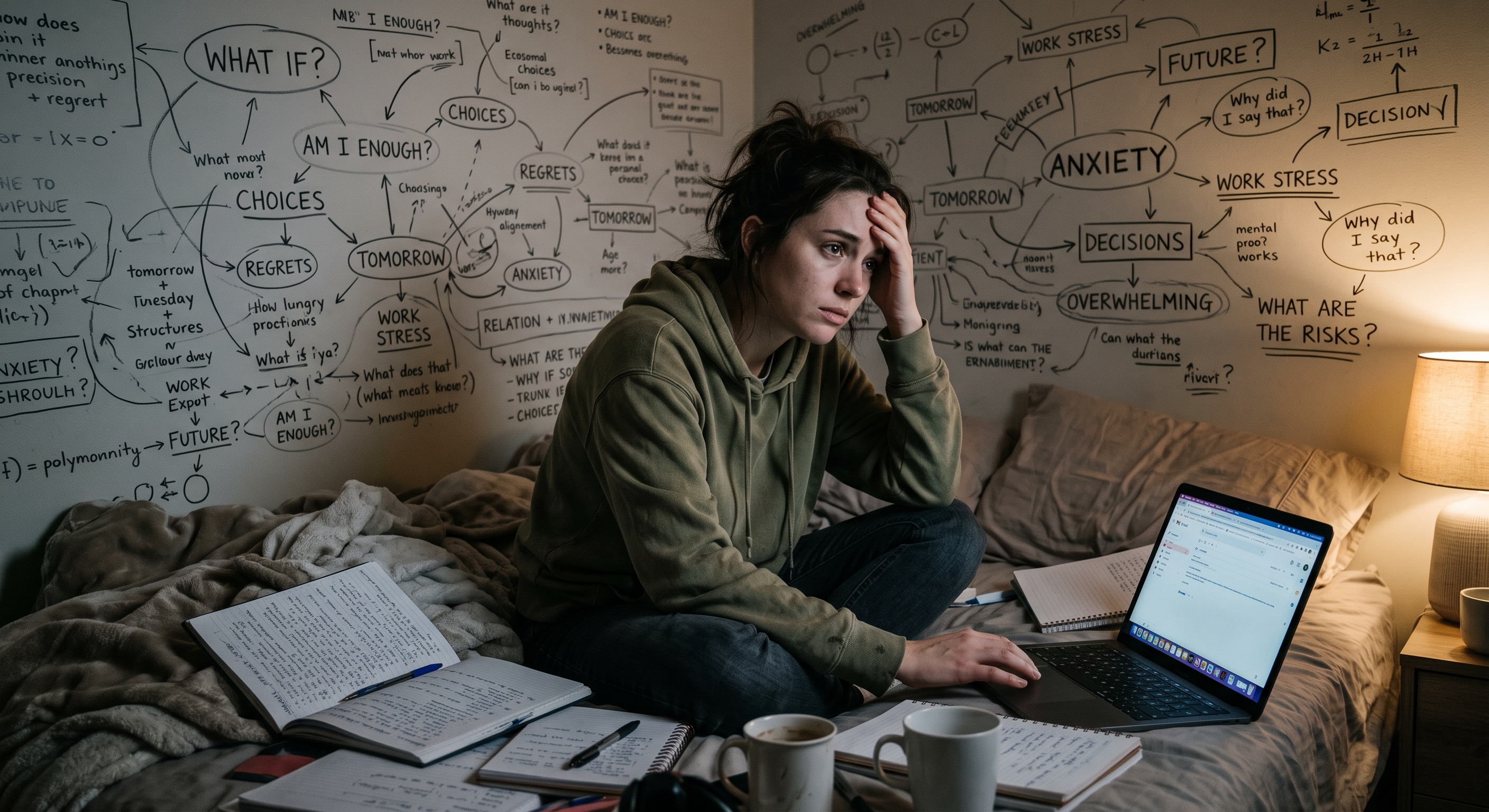
// Mantiki ya Kifiziolojia
The brain burns over 20% of metabolic glucose. During uncontrolled rumination, prefrontal overdrive and constant sympathetic muscle bracing drain energy reserves.
Kwa Nini Kufikiria Kupita Kiasi Kunauchakaza Mwili Wako
Sitting still while worrying intensely drains the body just as much as physical exertion. The nervous system cannot distinguish mental catastrophes from real physical threats.
How rumination and overthinking generate authentic physical fatigue
Mental worry activates the amygdala, triggering a steady trickle of cortisol and noradrenaline that keeps muscles in sustained micro-tension, burning energy while you sit still.
Mental worries create real involuntary muscle contractions that deplete physical fuel stores.
Default mode network hyperarousal and cellular ATP depletion
Continuous worry loops consume large amounts of cellular ATP in brain neurons. Subtle shallow breathing reduces carbon dioxide and cerebral perfusion, creating bodily heaviness.
Excessive rumination drains cellular energy and mimics the physical exhaustion of heavy exercise.
Chronic sympathetic vigilance, muscle tension, and digestive slowing
Overthinking diverts blood flow from digestion and immunity to skeletal muscles (jaw, shoulders, neck), leading to tension headaches and digestive sluggishness.
Knots in the shoulders, clenched jaw, and slow digestion are direct somatic results of mental rumination.
How to signal biological safety to reset your nervous system and save energy
Reasoning your way out of worry rarely works when the brain is exhausted. Use somatic exhalations (physiological sighs), relax the jaw, and write thoughts on paper to clear working memory.
Long exhalations and putting thoughts on physical paper break the mental cycle faster than willpower.
Wakati wa Kutafuta Huduma ya Matibabu
- • Severe depressive paralysis, inability to leave bed, or thoughts of self-harm.
- • Chest tightness with shortness of breath, dizziness, or pain radiating to jaw or arm.
- • Unexplained weight loss, debilitating insomnia over 3 weeks, or functional collapse.
- • Sudden muscle weakness, localized numbness, or neurological deficits.
- • Obsessive thoughts accompanied by hallucinations, severe panic, or disorientation.
Nini cha Kufanya Baadaye
If continuous overthinking disrupts your work, sleep, or relationships for over two weeks, seek support from a healthcare professional or therapist.
"Your mind does not overthink because it is defective; it does so to protect you. But protection becomes exhaustion when you require certainty before resting."
Anachokiona Mara kwa Mara DrLina
Conscientious individuals often disguise chronic anxiety under the label of 'responsibility.'
People feel guilty resting because their mind equates stillness with neglecting problems.
Most chronic neck and shoulder tension is sustained by unconscious worry during desk work.
Writing worries on a physical notepad reduces working memory strain by up to 40% immediately.
Cognitive Allostatic Load & Energy Drain Estimator
Constant worry loops drain mitochondrial ATP through sustained prefrontal activation. Two minutes of physiological sighing (double nasal inhale, prolonged oral exhale) activates the parasympathetic brake.
// Jinsi DrLina Inavyoweza Kukusaidia : Kwa Nini Kufikiria Kupita Kiasi Kunauchakaza Mwili Wako

Kadi hii ya utunzaji inaeleza jinsi msaidizi wa AI DrLina anavyofafanua ishara za mwili na dalili. Persistent cognitive rumination locks the default mode network (DMN) in hyperarousal, inducing sustained allostatic load and subclinical cortisol elevation that physically depletes cellular ATP and creates somatic fatigue.
Kwa Nini Kufikiria Kupita Kiasi Kunauchakaza Mwili Wako
Wasiwasi wa mara kwa mara huweka mfumo wa neva katika hali ya tahadhari. Hii hukaza misuli, kuvuruga usingizi na kusababisha uchovu mkubwa wa mwili bila kazi ya nguvu.
“Persistent cognitive rumination locks the default mode network (DMN) in hyperarousal, inducing sustained allostatic load and subclinical cortisol elevation that physically depletes cellular ATP and creates somatic fatigue.”
Mabadiliko ya kimwili (kama vile uchovu sugu wa asubuhi au usingizi usio na utulivu) hutokana na sababu mbalimbali za kimtindo, msongo wa mawazo, au maradhi ya kiafya. Ukipata usingizi mzito mchana unaohatarisha uendeshaji gari, kukatika kwa pumzi usiku, au maumivu ya kifua, wasiliana mara moja na daktari kwa uchunguzi wa ana kwa ana.
Cha Kumuuliza DrLina Kuhusu Hili
Gusa swali lolote kuliweka kwenye mazungumzo ya kitabibu.
Maswali Yanayoulizwa Mara kwa Mara
Can thinking too much actually burn calories?
Yes, but not in a way that leads to weight loss. The brain uses 350-400 calories daily. Rumination increases glucose uptake in the brain, but being physically stationary results in mental exhaustion rather than fat burn.
Why do my shoulders, jaw, and neck hurt when I overthink?
The brain views uncertainty as physical danger and triggers a protective startle reflex. The neck, shoulders, and jaw clench unconsciously, causing knots and tension headaches.
How can I stop overthinking at bedtime?
Keep a paper notepad by your bed and write down all pending concerns before sleeping. This cognitive download reassures your brain that tasks are recorded, allowing you to relax.
Persistent cognitive rumination locks the default mode network (DMN) in hyperarousal, inducing sustained allostatic load and subclinical cortisol elevation that physically depletes cellular ATP and creates somatic fatigue.
Primary Scientific Citations
Synthesized by the DrLina Clinical Intelligence Engine and reviewed by the Dr. Lina AI Medical Board against peer-reviewed clinical benchmarks:
Cognitive perseverative cognition and allostatic load: physiological wear-and-tear of rumination
Default mode network hyper-connectivity, somatic hyperarousal, and central fatigue pathways
Autonomic consequences of repetitive negative thinking: sympathetic overdrive, reduced vagal tone, and mitochondrial ATP depletion
Why You Crave Junk Food at Night
Learn why evening ghrelin surges, drop in leptin, and circadian fatigue trigger intense nighttime sugar and salt cravings.